Oregon DOT Policy Group uses DMDU to flip the script amid financial realities
Summary
By conducting a wide array of model runs to inform long-range planning, ODOT was able to tie its efforts to definite metrics and provide insights into funding decisions with robust solutions for each. This approach relied heavily on institutional knowledge and trust, a history of working with a strategic model platform, and an engaged consultant looking to develop the practice. As a result, the conversation has changed and the “script has been flipped”; however, there are still challenges uncertainty regarding the ability to continue planning for uncertainty. While ODOT is working to establish the necessary skills and models in-house, they have proven that times of great fiscal uncertainty are best met with a strong planning effort.
Introduction
Oregon DOT is a vanguard, for better and for worse.
Oregon DOT has been leading the practice on using strategic models to study climate policy impacts. The open-source model VisionEval arose from ODOT tools and has been in use for ten years to monitor adherence to Oregon’s strict GHG targets. It was through this monitoring that ODOT identified Oregon was significantly off-track from meeting its mid-century climate mandates.
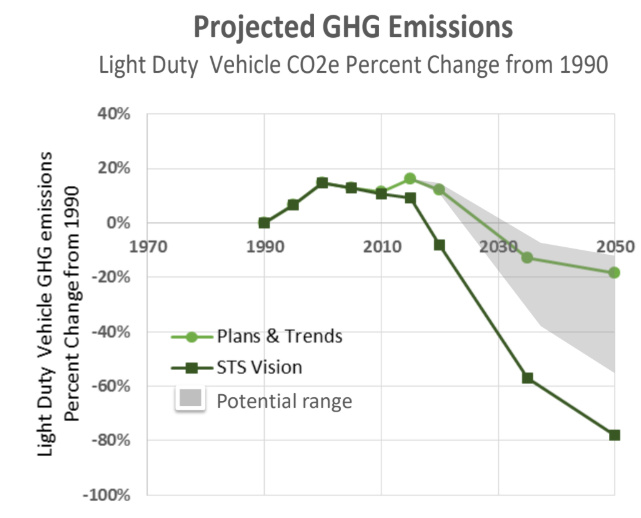
Source: ODOT Statewide Transportation Strategy (STS) Monitoring, 2018
On top of this, Oregon faces an unsustainable revenue forecast, characterized by an absence of a sales tax, no general fund support for transportation, and constitutional limitations that prevent road fees from being used for bicycle or walking infrastructure. This financial landscape makes their resource allocation decisions particularly critical, especially in the face of reduced gas taxes.
This confluence of challenges led leadership to acknowledge that status-quo planning assumptions were no longer viable and to support staff in trying something new. Fortunately, the ODOT staff and their consultant support were ready and willing to take that risk for the 2023 Oregon Transportation Plan.
Background
Leading into this work, ODOT benefited from several key advantages. The agency had long led the industry in the use of strategic models (e.g.., GreenStep, Regional Strategic Planning Model), which have since evolved into VisionEval. Furthermore, ODOT served as a beta-tester for TMIP-EMAT, integrating it with their new Activity-Based Model. Their OTP consultant was eager to advance industry practices in planning under uncertainty and two long-standing staff members, Tara and Alex, had earned the trust of DOT leadership through their established reputations for delivering high-quality work.
In addition to funding challenges, ODOT faced a ‘curse of success’ with its VisionEval model. VisionEval is a great tool for flexible, creative policy analysis, and for ODOT the tool became essential for meeting statutory targets and reporting requirements. This created a double-edged sword: while the model is now rigorously maintained to meet legal standards, any changes to it carry significant implications, requiring careful deliberation. Yet, this same stability and confidence have also empowered the agency to leverage the tool for increasingly expansive applications.
Doing The Work
Agency Buy-in
The initial scope for the 2023 Oregon Transportation Plan followed a traditional path, but ODOT decided to push the boundaries by leveraging their deep experience with VisionEval and a 2019 trial of TMIP-EMAT. Thanks to the established tenure and reputations of Alex and Tara, and bolstered by the enthusiastic support of the RSG consultant team led by Jonathan Slason, the team secured the backing of ODOT leadership to explore these new methods. This support provided the freedom and flexibility to utilize their model in innovative ways without the pressure of rigid expectations beyond the traditional plan. Their familiarity with the tools significantly reduced the risk of failing to meet basic planning needs, and they recognized the internal benefits of running the model numerous times across a wide range of inputs.
Modeling
The modeling approach utilized the XLRM framework to structure the analysis.
- This included identifying Exogenous Uncertainties (X), such as AV/CV deployment speeds, long-term telework rates, energy pricing, and ride-hailing economics.
- To address these, the team applied various Policy Levers (L), which encompassed Preservation & Adaptation, Strategic additions to road network, ITS/Operations, Electrification, Transportation options (TDM), Active Transportation, and Transit.
- The outcomes were measured through specific Metrics (M), including per capita Vehicle Miles Traveled (VMT), GHG emissions, household transportation ownership and operating costs, number of serious and fatal crashes, funding capacity for maintaining the system, and a custom Statewide Equity Index.
- Finally, the Relationships (R) within the model were governed by VisionEval, which was calibrated to household survey data for consistency with ten years of agency use, while highway disinvestment impacts were derived from Oregon’s Statewide Integrated Model investigations and prior applications. The disinvestment relationship formed an important post-process wrapper to the core Visioneval model allowing for a financially constrained optimization.
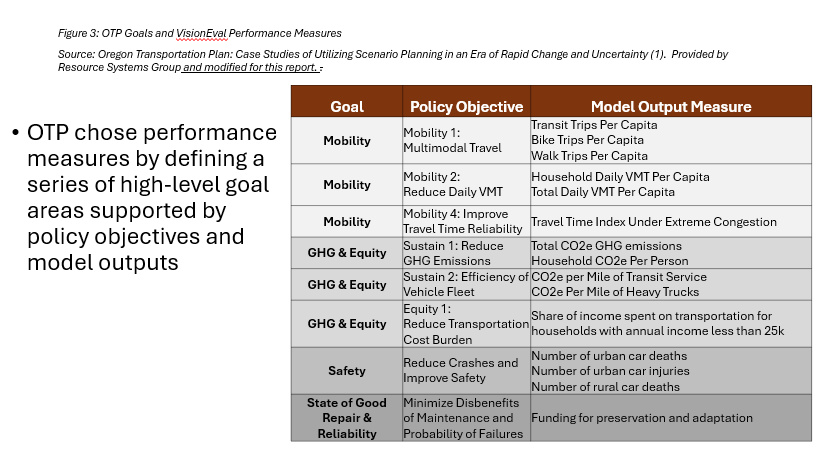
Source: Oregon Transportation Plan: Case Studies of Utilizing Scenario Planning in an Era of Rapid Change and Uncertainty
Creating this crosswalk between the OTP Goals with specific policy objectives that fall under those goals and the specific model outputs was critical to the success of this effort.
VisionEval
For the most part, VisionEval provided the level of detail for the policy questions at hand. The agency’s extensive experience with the tool, which allows for higher-level inputs that translate easily into different funding policies, was instrumental. Combining VisionEval with TMIP-EMAT allowed ODOT to “flip the script,” starting with their goals and giving an efficient method to search through hundreds of possible future outcome scenarios to find the policy mix that best satisfied those objectives within existing constraints.
Tara: “Traditional scenario planning starts with a few scenarios that pull certain levers and evaluate the outcomes against our goals. What we did this time instead, is we flipped it and said what our goals are. We ran a ton of scenarios and filtered them for which ones best achieved our goals.”
The tool proved particularly effective for evaluating funding mixes, as dollar amounts could be more readily translated into VisionEval inputs compared to network-based travel models that require significant detail, e.g., specific transit service routes, stops, and frequency changes. Structurally, VisionEval utilizes a “disaggregate demand/aggregate supply” setup; by processing synthetic populations without requiring computationally intensive network routing, it retains disaggregated household detail, while achieving exceptionally fast runtimes. Furthermore, the agency finds value in “stacking” their work over time, using a consistent abstraction layer to compare results from different models and create a reliable, long-term narrative. This includes incorporating road disinvestment functionality from another tool, recognizing and offsetting any specific tool limitations.
Interpretation and Presentation
In presenting their findings, the team distinguished between data intended for technical experts and insights meant for a broader audience. Not all numbers were included in figures and tables; many were translated into qualitative insights within the plan.The use of TMIP-EMAT allows variables to be explored as a continuous measure, rather than discrete runs of high-medium-low values. Without EMAT, the number of scenarios to more comprehensively cover the continuous space across multiple dimensions would create an unruly number of model runs. EMAT makes this manageable.
The TMIP-EMAT interface provides easy to interpret charts that can show relationships between two to three variables as well as quickly communicate the strength of the relationship between specific inputs and outputs. The OTP team partnered with staff throughout the agency to align on a financially constrained approach and used transportation funding as the common denominator when discussing plan actions with policy makers.
Recognizing that these complex tools are not designed for the general public, the planners and modelers took on the challenge of innovating ways to take advantage of the model’s strengths in communication. One example was the use of “Transportation Personas,” which quantified and visualized how individual households across various demographics (from the model’s synthetic household results) would realistically experience different uncertain futures. Dashboards were developed to allow users to select the level of transportation funding (with the associated road user fees specified) and then select from the various investment buckets. Outcomes were shown to the user to demonstrate how performance measures change based on the investment selections. It became evident to the stakeholders using the tool that tradeoffs and tough decisions are necessary.
Outcomes
The ODOT team met their obligation to develop the Oregon Transportation Plan and provided several benefits to the planning process, discussion of transportation challenges, and the transportation planning and modeling practice.
Alex B: “I walked away from this work very happy… the agency is talking in ways that are in my mind new and a different foundation… [the previous plan] was very traditional. This work said more than if you have more money things are better. It only allowed you to understand the tradeoffs including the benefits of spending the revenue that you had raised under higher fees. And showed how the higher per mile fees would help keep growth in VMT in check, with associated benefits to the environment, safety, road growth, etc..”
A Win-Win-Win
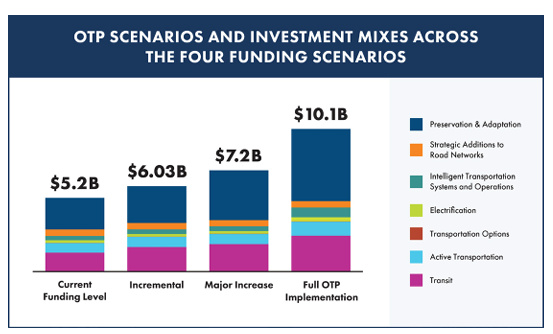
The first win from this work is useful insights into implications of funding scenarios. At each funding level, the scenarios that best met the goal was different. This led to a different recommended mix of what to fund (bar charts below). Much of the agency’s current work continues to point back to these core scenarios, which were finalized in 2023. They serve as a foundational starting point for subsequent efforts, including the upcoming highway plan. Having the scenarios robustly analyzed builds confidence in the findings and provides a solid foundation for future work.
A second key win is the advancement of the transportation planning and modeling practice, particularly the use of VisionEval and TMIP-EMAT. ODOT’s organization of strategic models in a planning process along with the key monitoring feedback grounds the use of these tools, ensuring their accuracy, providing policy makers confidence in using less specified models to inform long-range policy decisions.
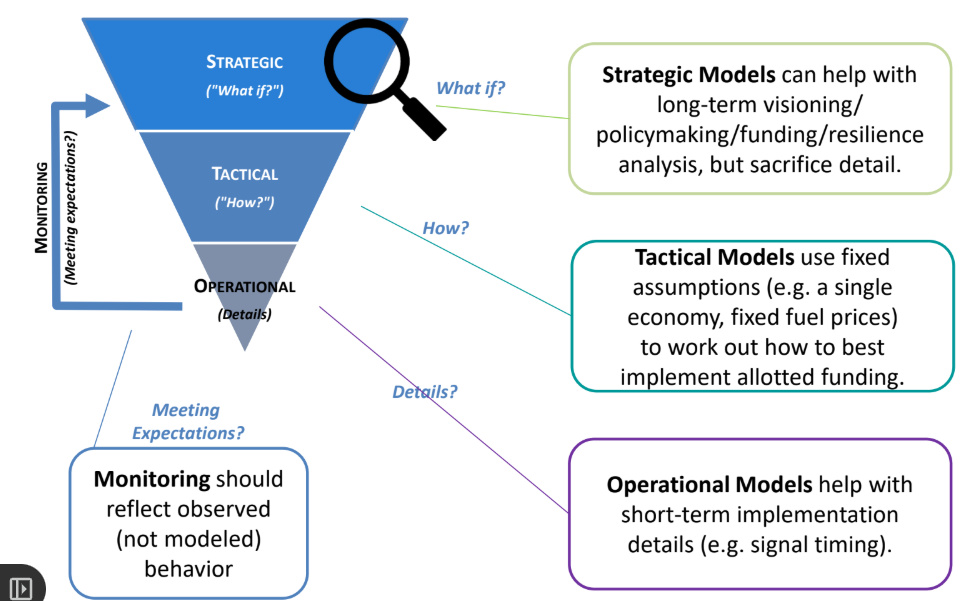
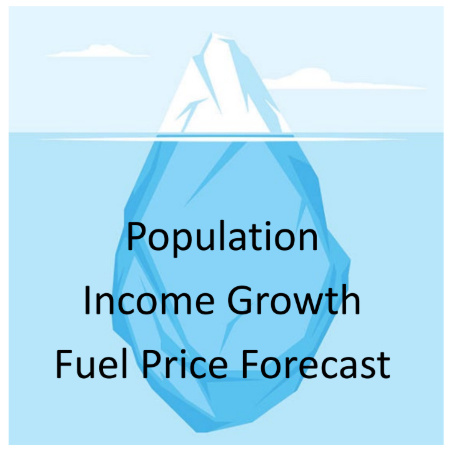
Most importantly, this work enabled leadership to clearly distinguish between controllable factors and external pressures. The future is inherently uncertain. By working with tools that can account for a wide range of that uncertainty and still provide guidance to policy makers is a unique strength that brought tremendous value to the OTP.
The iceberg metaphor illustrates this dynamic: while the agency’s direct influence remains visible above the waterline, a vast, submerged mass of uncontrollable forces continues to shape the future.
An example of how the robust analysis enabled the plan to be direct in raising the awareness (and alarm) is captured in this quote about the difficult decisions to be made, including disinvestment in the transportation system:
“With insufficient resources the OTP becomes more important than ever to help ensure that what little money is available is directed in ways that can best support the movement of people and goods. Unprecedentedly difficult tradeoffs lay in front of Oregonians. The long-term impacts of deferred maintenance are now no longer avoidable and Oregon is in a current state of disinvestment in its transportation system. What this means in the upcoming years and throughout the OTP’s planning horizon is that, while there will be some gains and investment in some areas, there will also be nearly impossible trade-off discussions which will have significant impacts on people’s lives, communities, and the economy.” www.oregon.gov/odot/Planning/Documents/Oregon_Transportation_Plan_with_Appendices.pdf
Future Work
ODOT is actively working to build in-house capabilities to continue use of VisionEval and TMIP-EMAT to address new questions and maintain an “uncertainty heartbeat” for their ongoing planning work. Currently, ODOT continues to be a driving force behind the future development of VisionEval and a key supporter of the Pooled Fund partnership, as they encounter more complex questions and build corresponding capabilities within the tool. The team recognizes the critical need to establish internal expertise for testing purposes so they can adjust models without relying solely on external consultants, though they currently face resource and staff limitations in achieving this goal.
Looking ahead, ODOT acknowledges that while bringing together existing tools was an expedient solution, it arrived with inherent limitations. ODOT is focused on a near-term solution to replicate the work in-house to update the guidance as the funding outlook evolves and new uncertainties unfold. The challenge to make smart funding recommendations and ensure funding is accountable to achieving the agency goals continues.
Jonathan: “This work represents an exploration of a wide range of unknown knowns with one model framework. It could be reasonable to also develop some alternative versions of the core equations that estimate household travel demand. Using the TMIP-EMAT framework, we could call that alternative(s) package and that would even further give us a greater range of future experiments. This would take it further along the DMDU pathway and actually start using not only changes in the inputs, but actually the relationship model.”
More broadly, the work could eventually move toward a system of models—a “model universe”—that allows insights from a disparate set of analytical tools to be integrated without the need to resolve their individual outcomes. Such a system, perhaps utilizing a system dynamics model, could transcend current challenges while preserving the valuable contributions of earlier work that were so vital to the success of the 2023 plan. More research and conceptualization are needed to turn this vision of an integrated modeling environment into a reality.
Conclusion
The success of this initiative relied heavily on ODOT’s long-standing expertise with VisionEval and TMIP-EMAT, the established reputations of Tara and Alex, and RSG’s willingness to push the boundaries of standard planning. By leveraging a conventional project, the team effectively advanced the agency’s modeling practice. While significant work remains to institutionalize these methods, the momentum is strong: ODOT is supported by a robust VisionEval community, the ongoing commitment of its key internal experts, and a leadership team now accustomed to deeper, more data-driven insights into the implications of their decisions.
References
- Oregon Transportation Emissions Website
- 2023 Oregon Transportation Plan (OTP) Hub
- VisionEval Open Source Project Documentation
- Oregon Greenhouse Gas White Paper (ODOT Modeling Steering Committee)
- Tara’s presentation at TRB AM Future Uncertain workshop
Acknowledgments
The authors would like to acknowledge the following people for their contributions, guidance and review of this case study
- Alex Bettinardi, P.E., Senior Transportation Modeler, Oregon Department of Transportation
- Jonathan Slason, Managing Consultant, RSG
- Tara Weidner, Climate Impact Program Lead, Oregon Department of Transportation Climate Office
Disclaimer The statements included are the personal opinions of those quoted and do not represent the official policy or position of Oregon DOT.